
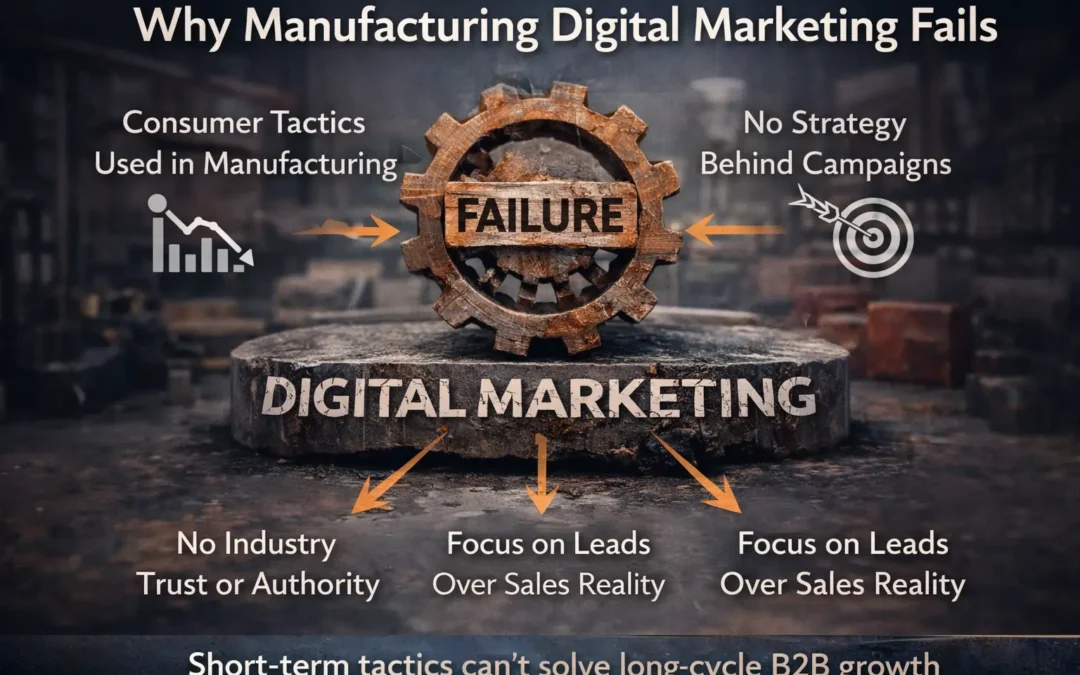
Manufacturing digital marketing fails when strategy is replaced by tactics. Manufacturing digital marketing rarely fails because manufacturers lack ambition, budget, or intent.
It fails because the structure of digital marketing applied to manufacturing businesses is fundamentally misaligned with how manufacturing actually grows.
Across industrial sectors, manufacturers invest in websites, SEO, content, paid ads, and social media. Activity increases. Dashboards look busy. Reports show impressions, clicks, and engagement. Yet when leadership asks a simple question, “Is this helping us win better business?” the answer is often unclear.
This gap between effort and outcome is not accidental. It is the result of digital marketing frameworks designed for fast-moving consumer or SaaS markets being forcefully applied to manufacturing environments that operate on trust, risk mitigation, and long-term decision-making.
This article breaks down why manufacturing digital marketing fails so consistently, what most agencies misunderstand about industrial growth, and how the right manufacturing digital marketing agency fixes the problem by shifting from tactics to systems.
Why Manufacturing Digital Marketing Fails at a Structural Level
Manufacturing is not a marketing-led industry.
It is a reliability-led industry.
Buyers do not look for excitement. They look for certainty.
Consumer Marketing Logic Is Applied Where It Doesn’t Belong
Most digital marketing agencies are trained in environments where:
- Attention is short-lived
- Decisions are emotional
- Purchases are reversible
- Speed matters more than certainty
Manufacturing buying decisions are the opposite.
They are:
- Slow and deliberate
- Rational and risk-driven
- Often irreversible
- Dependent on long-term outcomes
When agencies apply consumer-style tactics, rapid campaigns, creative hooks, short-term offers, to manufacturing, the result is marketing that feels active but doesn’t move decisions forward.
Visibility increases, but confidence does not.
Manufacturing Buyers Don’t Reward Presence, They Reward Judgment
A common assumption in digital marketing is that showing up consistently builds trust.
In manufacturing, judgment builds trust, not presence.
Buyers pay attention to:
- How problems are framed
- Whether trade-offs are acknowledged
- How complexity is handled
- Whether uncertainty is addressed honestly
Marketing that simplifies everything into slogans and promises may work in other industries. In manufacturing, it raises red flags.
This is why many manufacturers feel that digital marketing “looks good” but doesn’t translate into serious conversations.
The Long Sales Cycle Problem Most Agencies Ignore
Manufacturing sales cycles are not just long, they are layered.
Decisions Are Distributed, Not Centralized
A single manufacturing deal may involve:
- Engineering teams
- Procurement
- Operations
- Finance
- Senior leadership
- External consultants or partners
Each stakeholder evaluates risk differently. Digital marketing that speaks only to one role creates friction instead of alignment.
Most agencies design funnels as if:
- One person discovers
- One person evaluates
- One person decides
Manufacturing doesn’t work that way.
Campaign Thinking Breaks in Long Cycles
Campaigns assume a beginning and an end.
Manufacturing buying journeys rarely follow such neat timelines. Buyers may:
- Research for months
- Pause due to internal constraints
- Resume when priorities shift
- Re-evaluate vendors repeatedly
Marketing that resets every quarter loses accumulated trust.
This is why manufacturers often see:
- Leads coming in bursts
- Long gaps of inactivity
- Inconsistent quality of inquiries
The issue is not demand, it’s continuity of authority.
The Most Common Manufacturing Digital Marketing Mistakes
Manufacturing digital marketing rarely collapses dramatically.
It erodes quietly through repeated strategic errors.
Mistake 1: Treating Visibility as a Growth Metric
Many manufacturers equate:
- Rankings with demand
- Traffic with intent
- Engagement with trust
Visibility is not influence.
A buyer may see your brand many times and still not believe you are a safe choice. Without authority, visibility only increases familiarity, not confidence.
This is why publishing frequently without clarity leads to noise, a concept explored deeply in Consistency Is Not a Strategy in B2B.
Mistake 2: Optimizing for Lead Volume Instead of Sales Reality
Lead volume is attractive because it is easy to measure.
But manufacturing sales teams rarely struggle with too few conversations. They struggle with:
- Poorly informed inquiries
- Price-focused leads
- Non-decision-makers
- Early-stage researchers
Marketing that prioritizes quantity forces sales teams into educational roles instead of consultative ones.
This disconnect slowly erodes trust between sales and marketing.
Mistake 3: Ignoring Distribution and Channel Complexity
Many manufacturing businesses:
- Sell through distributors
- Operate across regions
- Depend on partners for fulfilment
- Balance direct and indirect sales
Digital marketing that assumes a direct-to-buyer funnel ignores this reality.
When marketing bypasses channels or contradicts partner positioning, it creates internal friction rather than growth.
Why Strategy Must Come Before Tactics in Manufacturing
Manufacturing digital marketing improves only when strategy is treated as infrastructure.
Authority Is the True Conversion Mechanism
Manufacturing buyers convert when they feel:
- Understood
- Protected from risk
- Confident in long-term outcomes
Authority is not built through repetition.
It is built through reasoning.
This is why manufacturing growth increasingly depends on authority-led growth systems, a strategic framework associated with long-term positioning and judgment (shivendrasingh.com).
SEO Without Authority Creates the Wrong Traffic
Manufacturing SEO often fails because it chases keywords instead of intent.
Ranking for broad terms brings:
- Students
- Job seekers
- Generic researchers
Authority-driven SEO focuses on:
- Decision-stage queries
- Technical context
- Industry-specific language
Without authority, traffic increases but relevance declines.
How the Right Manufacturing Digital Marketing Agency Fixes the Problem
The difference between failure and compounding growth is not execution quality.
It is perspective.
Business Reality First, Marketing Channels Second
A manufacturing-focused agency begins by understanding:
- How deals are won
- Where deals stall
- What objections repeat
- Which risks delay decisions
Only after this analysis does channel execution begin.
This approach is central to how manufacturing digital marketing agency partners, such as SADVY, design growth systems by aligning marketing with commercial reality rather than platform trends.
From Campaigns to Compounding Systems
When marketing is built as a system:
- Content accumulates authority
- SEO reinforces credibility
- Paid media amplifies trust
- Sales cycles shorten organically
Marketing stops behaving like a cost center and starts functioning as decision support.
Why Manufacturing Marketing Requires Patience and Precision
Manufacturing growth is incremental but durable.
Trust Compounds Slower Than Traffic, But Lasts Longer
Traffic spikes disappear.
Authority remains.
Manufacturers who invest in precision marketing see:
- Fewer but stronger inquiries
- Higher-quality negotiations
- Better alignment with procurement
- Reduced pressure on pricing
This is not fast growth.
It is stable growth.
Precision Beats Frequency in Industrial Markets
Publishing more does not equal communicating better.
Manufacturing buyers value:
- Clear thinking
- Honest constraints
- Real trade-offs
- Practical implications
Marketing that respects complexity earns attention.
What Manufacturers Should Expect When Marketing Is Done Right
Manufacturing digital marketing does not feel dramatic.
It feels calm.
Over time, manufacturers notice:
- Prospects referencing content in meetings
- Shorter explanation cycles
- Higher baseline trust
- More strategic conversations
These are signals of authority not vanity metrics
Manufacturers who see sustainable results usually follow strategic frameworks grounded in experience, clarity, and long-term judgment — the same principles behind strategic authority-led thinking applied across industrial growth systems..
The Hidden Cost of Getting Manufacturing Marketing Wrong
When digital marketing is misaligned, the damage is subtle but expensive.
Manufacturers experience:
- Brand dilution
- Confused positioning
- Internal skepticism toward marketing
- Lost credibility in the market
Recovering from this damage takes longer than building it correctly the first time.
Why Manufacturing Needs Specialized Digital Marketing Partners
Manufacturing is not a niche.
It is complex.
Complexity requires:
- Industry familiarity
- Strategic patience
- Judgment-based decisions
A generic agency may deliver activity.
A manufacturing digital marketing agency delivers alignment.
Manufacturing Growth Is a Strategic Decision, not a Tactical One
Manufacturing leaders increasingly recognize that digital marketing is unavoidable.
The real decision is how it is approached.
When marketing is treated as execution, results fluctuate.
When marketing is treated as strategy, results compound.
Summary
Manufacturing digital marketing fails not because manufacturers are doing too little, but because they are doing the wrong things for the wrong reasons.
Short-term campaigns, lead volume metrics, and consumer-style tactics do not align with how industrial buyers make decisions. Manufacturing growth depends on authority, trust, and systems that reduce risk over time.
The right manufacturing digital marketing agency fixes this by designing marketing around business reality, not platforms. When strategy leads and tactics follow, marketing stops resetting every quarter and starts building long-term demand.